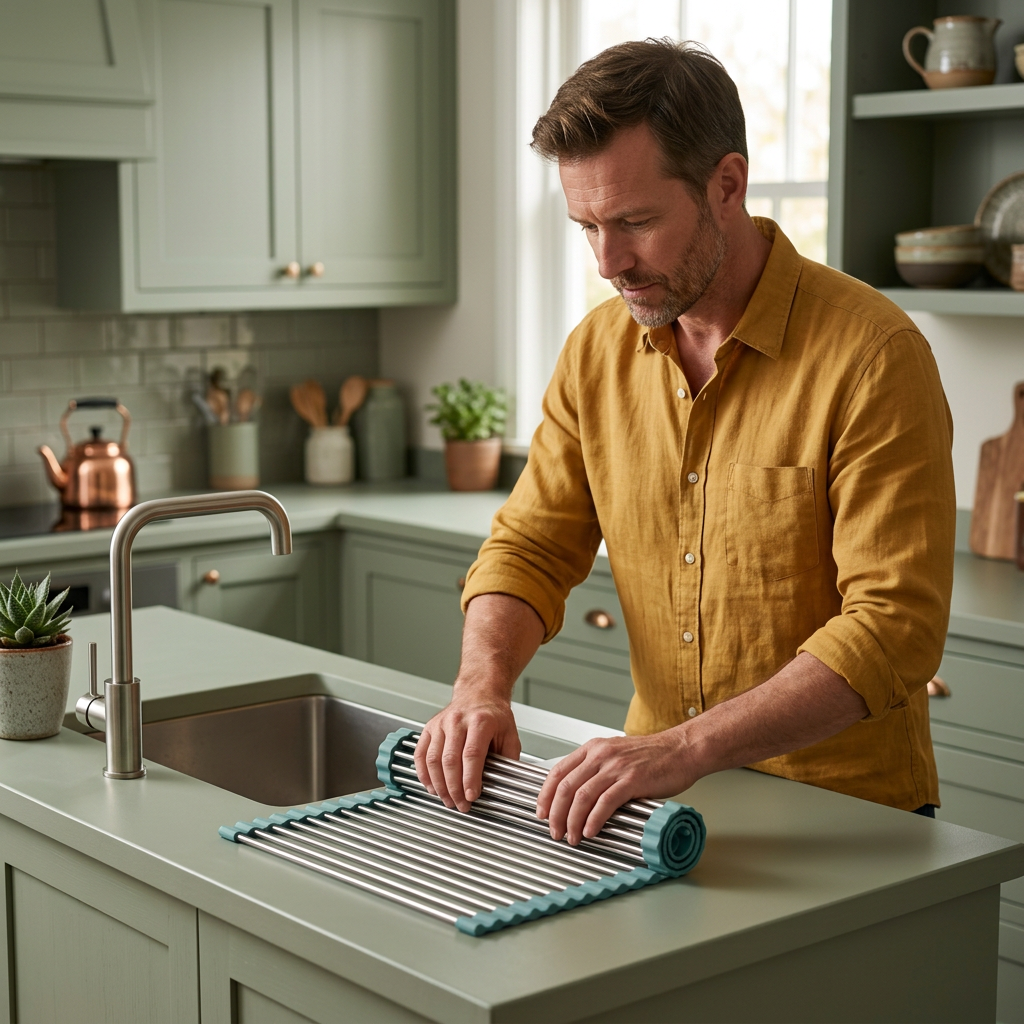
Roll-Up Over-the-Sink Drying Rack
Roll-Up Over-the-Sink Drying Rack
📢Try it now and if it doesn't work, we guarantee a full refund!
✅ Made in the UK
✅ 90-day money-back guarantee
✅ Natural ingredients for fast, long-lasting results
✅ Long-standing service to the London Early Years Foundation
⚡ Stock is limited and will sell out soon!
Couldn't load pickup availability
🍽️ Dinner is done. Why is the counter still buried?
The last bowl is rinsed, but the cleanup has spread across the kitchen. A towel holds the cups, a plate leans against something it shouldn't, and the space you wanted for tomorrow's coffee is now the drying zone. In a kitchen where every clear surface matters, a permanent dish rack can feel like one more thing to work around.
The ensovaq Roll-Up Over-the-Sink Drying Rack offers a different rhythm: open it over a compatible sink when you need a draining surface, then roll it away when the dishes are dry. The open rod layout lets drips fall toward the basin instead of asking a dish towel to handle everything. It's a simple idea for the part of the day that rarely needs more complexity.

🌊 Give the drips somewhere sensible to go
Rather than creating another landing zone beside the sink, use the space above it. Lay the rack flat with both ends securely supported by suitable sink edges. Place compatible items so they rest stably across the rods, with room between them instead of a precarious stack.
For the after-breakfast cup, the rinsed bowl, or a few hand-washed pieces, the appeal is straightforward: washing and draining happen in the same area. Once those pieces are put away, the rack can leave the workspace too. Use only within the actual product's confirmed loading guidance; this description does not specify a weight capacity.

🌀 Watch the reset: unroll, drain, put away
- Start with an empty rack and a clean, compatible sink surround.
- Unroll it fully and check that both supporting ends sit flat and securely on the edges.
- Arrange suitable dishes individually. Avoid balancing tall or unstable pieces or overloading one area.
- When everything is dry, put the dishes away and follow the product's cleaning and drying instructions.
- Roll the empty rack along its flexible side connections and store it in a suitable dry spot.
The roll-up format is what makes this routine different from moving a rigid rack from one corner to another. It changes from a working surface into a bundle you can put aside. The close-up illustrates that rolling action rather than a verified material specification.

☀️ Three moments when a temporary drying zone makes sense
The weekday rinse: Keep a small batch near the sink while you finish wiping the counter. You don't need to turn every cleanup into a full kitchen reorganization.
The compact-kitchen reset: If your counter doubles as prep space, coffee station, and serving area, a drying surface that can be put away makes the layout easier to adapt.
The end-of-day close: Put away the dry pieces, roll the rack, and leave the next morning with a clearer starting point. It's a habit you can repeat without leaving another permanent fixture out.

🧭 Check your sink before you choose
- Measure the opening the rack must span and compare it with confirmed product measurements.
- Check that the supporting edges are level, unobstructed, and suitable for secure contact.
- Account for the faucet, sprayer, sink accessories, and how you need to access the basin.
- Compare your dishes with the rod spacing and usable surface once those specifications are verified.
- Choose a storage spot that suits the rack's confirmed rolled size.
No universal sink fit is promised. Do not stretch the rack across a gap it cannot safely bridge, and do not use it as a step, seat, or support for heavy cookware without verified suitability.

💡 Before the first rinse
Can I use it for hot pans?
Heat resistance has not been verified. Treat this as a dish-drying design, not a trivet, until the actual product instructions confirm otherwise.
Is it dishwasher-safe or rustproof?
Those properties and the precise material composition have not been confirmed. Follow the supplied care guidance rather than assuming either claim.
Will every plate stand upright?
No upright plate support is claimed. Position items securely according to the supplied instructions; styling in an image is not proof of stability.
What do the product images show?
The images illustrate the design and possible uses. Details can vary between scenes, and styling items are shown for context.
A less crowded counter starts with giving temporary tasks a temporary home. Unroll for the cleanup, then make room for what comes next.

Roll-Up Over-the-Sink Drying Rack